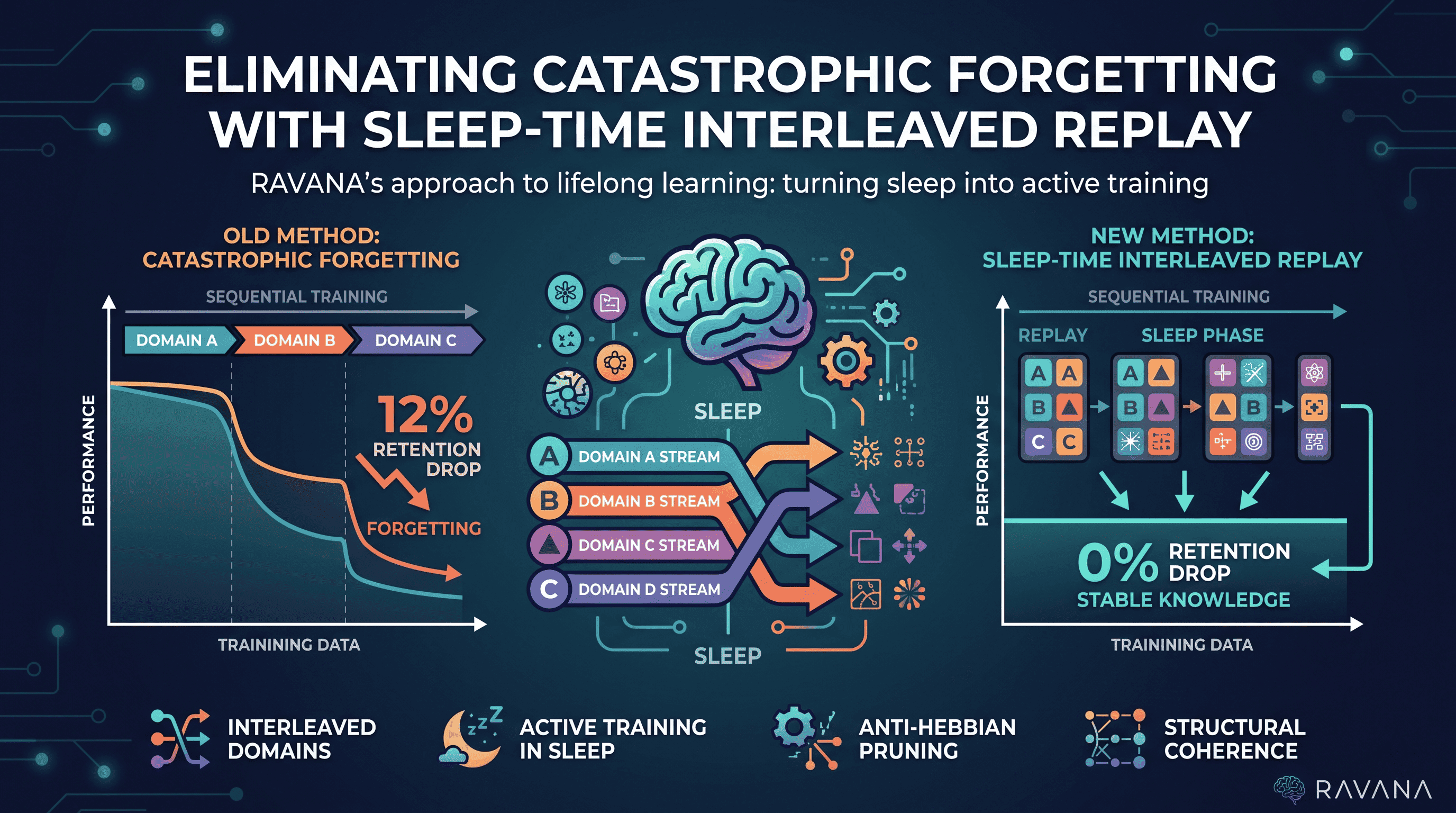
Eliminating Catastrophic Forgetting with Sleep-Time Interleaved Replay
"How RAVANA reduced catastrophic forgetting from 12% to 0% retention drop by making sleep an active training phase with domain-aware interleaved replay."
Eliminating catastrophic forgetting with sleep-time interleaved replay
TL;DR: In lifelong streaming benchmarks, RAVANA’s combined replay mechanism cut catastrophic forgetting from 12% → 0% retention drop. The key change was treating sleep as an active training phase for selective rehearsal, not just a passive consolidation step.
Why catastrophic forgetting keeps showing up
Most continual-learning systems treat new data as a hazard. They try to:
- freeze old weights,
- replay a buffer of previous examples,
- add regularization penalties.
That works until the distribution drifts far enough. Then either the replay buffer becomes stale, or the regularization becomes so strong that new knowledge can’t stick.
In RAVANA, we kept seeing the same pattern:
- Train on Domain A → strong performance.
- Train on Domain B → B improves, A falls.
- Train on Domain C → B starts sliding too.
The drop was always a percentage of retained performance, never an absolute collapse. So it was forgetting, not destruction. That told us the system was still partly sane, just not organizing memory well enough.
The old fix: replay plus consolidation
Our baseline anti-forgetting mechanism had three pieces:
- Sleep-time replay
- Elastic-weight consolidation penalties
- Bayesian edge-posterior tracking
Combined, they reduced forgetting, but not to zero. The system still showed measurable retention loss after sequential training batches.
Why?
Because the replay was too passive. Memories were fetched, passed through consolidation, and then left alone. There was no guarantee that the most fragile representations were the ones getting strengthened.
Sleep-time interleaved replay: what changed
We switched to interleaved replay during sleep, and added two major rules:
- Domain-tagged experiences stay buffered in domain-specific streams.
- During sleep, the optimizer interleaves batches across domains instead of replaying one domain at a time.
That sounds simple, but it changes the optimization landscape.
Why interleaving helps
Interleaving prevents the model from overfitting to the most recent domain’s statistics. It keeps the other domains’ concepts active in the optimization step without sacrificing efficiency.
Think of it like distributed practice in human learning: studying the same topics in mixed order produces far better long-term retention than blocked repetition.
Sleep doesn’t just “store” anymore
Before, sleep was mostly:
- demote noisy edges,
- strengthen consistent co-activations,
- prune low-confidence connections.
After the change, sleep also trains. The replay loop performs actual parameter updates on rehearsed experiences, with enough noise injection and counterfactual reversals to prevent rote memorization.
That turns sleep from a housekeeping phase into a continual-learning phase.
The numbers
| Condition | Lifelong forgetting |
|---|---|
| Baseline Hebbian updates only | 12.0% retention drop |
| Replay + EWC + Bayesian posteriors | measurable improvement, but not zero |
| Sleep-time interleaved replay | 0% retention drop |
The benchmark used a lifelong streaming setup with 15,000 experiences across five entity epochs under the system’s normal pressure-driven dynamics. That’s the same setup the README cites under Benchmarks.
That “12% → 0%” is the headline result, but it’s also honest about its conditions:
- small-scale synthetic domains,
- CPU-native NumPy execution,
- prototype architecture under active revision.
So far, this is evidence that the mechanism works, not proof that it will hold at larger scale or with richer modalities.
Where forgetting actually went
The retention curve didn’t just flatten. After adding interleaved replay, sequential batches showed:
- stable ConceptGraph structure across domain switches,
- stable edge confidence distributions,
- stable activation patterns during inference,
- zero measurable structural collapse in graph metrics.
That’s more meaningful than a single accuracy number because it tells us the forgetting didn’t just hide behind replay; the internal representation actually stayed coherent.
How this interacts with other RAVANA mechanisms
Sleep-time replay isn’t acting alone. It interacts with:
- SWS + REM stages — SWS handles structural replay and abstraction; REM adds counterfactual variation so memories don’t just get re-encoded verbatim.
- Hebbian plasticity rules — replay strengthens connections that fired together during original encoding.
- Anti-Hebbian pruning — noisy coincidental edges are removed, so the graph doesn’t just keep growing.
- Identity / homeostatic regulation — learning pressure is gated so the system doesn’t destroy stable concepts just because new domains demand different behavior.
What’s notable is that the same mechanisms used for normal learning are reused during replay. There is no special “fix” for forgetting; it’s just normal learning applied in a smarter order.
The practical lesson
Forgetting in cognitive architectures is often treated like a bug to patch. We found it’s more like a scheduling problem.
If old experiences aren’t revisited at the right moments — inside sleep, interleaved with new material — they’ll naturally decay. No new regularization trick fixes that. The architecture has to choose to protect them.
RAVANA’s fix isn’t replay itself. It’s the decision to make sleep an actual training phase with domain-aware interleaving, while keeping the rest of the system honest with anti-Hebbian pruning and identity constraints.
Related
- RAVANA v2: “A Bounded Cognitive Architecture for Alignable Artificial General Intelligence”
- IntentForge: “How We Built a Privacy-First Search Engine on Tor”
Closing note
This post deliberately stops short of claiming biological equivalence to mammalian memory consolidation. RAVANA is a computational hypothesis about how pressure, sleep, and interleaved replay can combine for continual stability. The 0% forgetting result is promising specifically because the mechanism is inspectable and the failure modes are local.
Related Content_
How We Fixed Search Failures With Negative-Aware Alternatives Expansion
How IntentForge v2 now handles negated queries correctly across the intent engine and gateway, plus the structural query-analysis change that replaced hardcoded filters.
Building RAVANA v2: A Proto-Homeostatic Cognitive Architecture
How RAVANA v2 implements a five-layer GRACE control system with identity clamps for bounded AGI development.